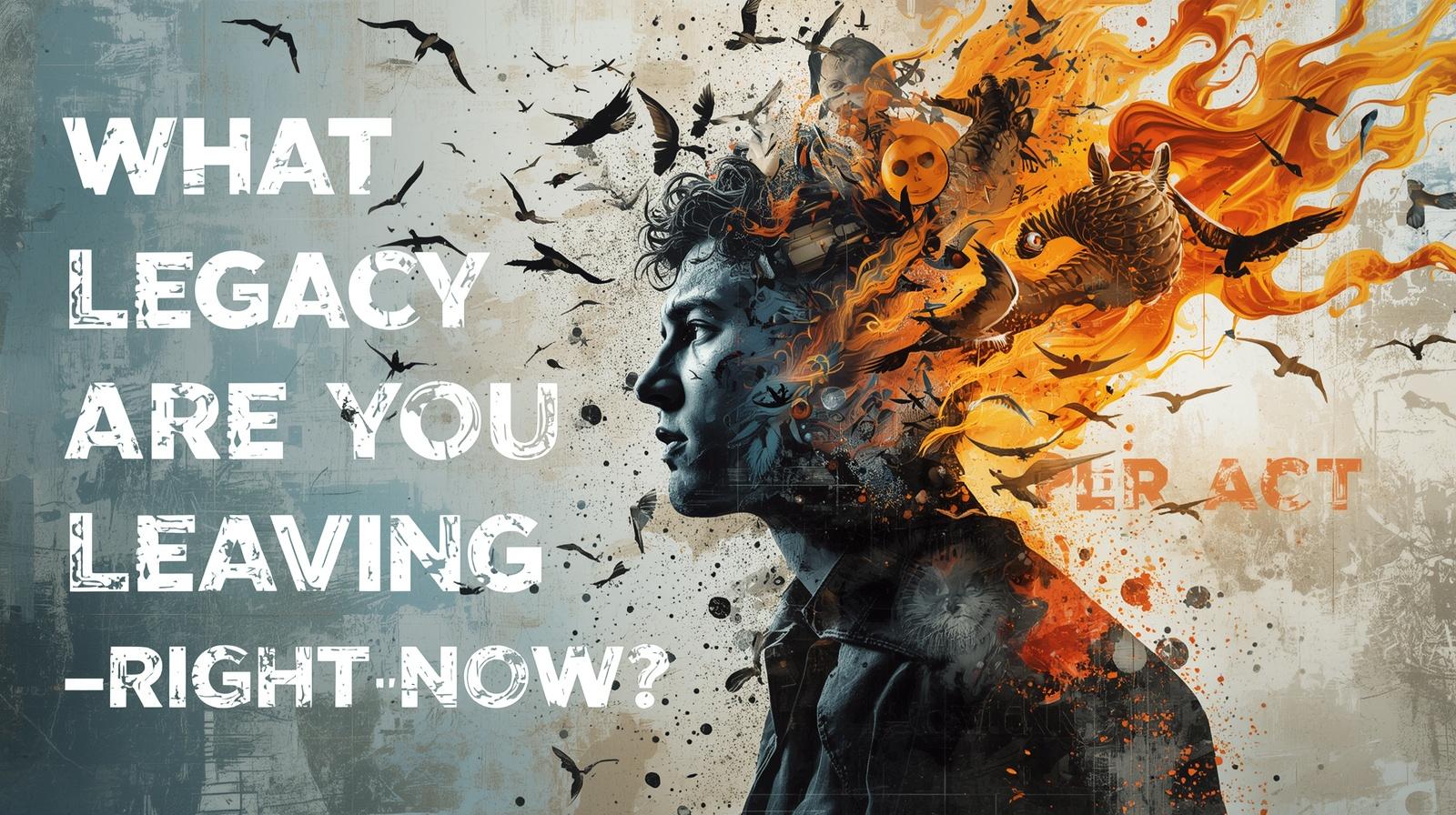
What Legacy Are You Leaving—Right Now?
Most people don’t really think about legacy unless something big is happening, like the end of a career, or the end of a life, or one of those moments where everything gets wrapped up and summarised in a way that makes it sound neat and intentional.
And because of that, it ends up feeling quite distant, almost like it belongs to a version of you that doesn’t exist yet — a future version who’s got things figured out, who’s done the important things, who’s somehow clearer than you feel right now.
But the reality is, it doesn’t work like that.
Because legacy isn’t something that suddenly appears at the end of your life, or something you consciously sit down and create one day, it’s something that’s already being built in the background, in a much quieter and less obvious way, just through how you go about your day-to-day life.
Prefer to listen on your favourite podcast app..?
Legacy Isn’t in Big Moments—It’s in Patterns
It’s easy to think that who you are is defined by the big moments, the high-pressure situations, the decisions that feel important at the time, the things you might look back on and point to as turning points.
But most people don’t experience you in those moments.
They experience you in the ordinary ones, the repeated ones, the ones that don’t feel like they matter that much when they’re happening.
The way you respond when you’re tired and someone needs something from you, the way you handle frustration when things don’t go your way, whether you actually listen to someone or whether you’re just waiting for your turn to speak.
Those moments don’t stand out individually, but they repeat, and over time they start to form a pattern.
And that pattern is what people come to recognise.
Not a list of things you’ve done, but a sense of what it feels like to be around you, whether things feel calmer or more tense, whether people feel heard or slightly dismissed, whether they relax around you or hold something back.
You Already Have a Legacy
And this is the part that can feel a bit uncomfortable when you really sit with it, because it means that legacy isn’t something you get to decide later on, once you’ve worked everything out.
You already have one.
Not in a dramatic or visible way, but in a very real, human way, because people are already having an experience of you, and they’re already forming a sense of what it’s like to be around you.
And you don’t get to pause that and come back to it when you’re ready.
It’s happening anyway.
But at the same time, there’s something quite reassuring about that, because if it’s being built through small, repeated moments, then it isn’t fixed, and it doesn’t require anything dramatic to shift.
It just requires a bit of awareness.
Presence Is Doing More Than You Think
Because a lot of what shapes that experience isn’t what you say about yourself, or how you explain who you are, it’s the way you show up consistently over time.
People pick up on things without you needing to point them out, like whether you’re someone they can be honest with, whether you make situations feel steadier or more intense, whether you take responsibility when something goes wrong or whether you move away from it.
And they’re not analysing it in a conscious way, they’re just feeling it, and that feeling tends to stick.
That’s why you sometimes hear someone say, “I don’t know why, but I trust them,” and there isn’t a clear reason they can point to.
It’s not about one moment, it’s about repetition.
A Simple Reflection: The Legacy Letter
If you want to get a bit clearer on the kind of patterns you’re creating, it can help to step back slightly and look at things from a different angle.
Not in a big, overwhelming way, just something simple.
Imagining yourself a bit further down the line, not completely different, not suddenly sorted, just a slightly more settled version of you, and asking what actually matters in terms of how you’re living.
Not what you’ve achieved, or what it looks like from the outside, but how you’re showing up day to day.
You might find yourself thinking about things like staying calmer when things get tense, or being more honest even when it feels uncomfortable, or not losing yourself trying to fit into situations that don’t quite sit right.
And those things might seem small, but they’re the ones that repeat, and the ones that shape everything else.
The “Living Like It Matters” Plan
You don’t need a big plan to start doing this differently, and you don’t need to map out the next five years.
You just need something small and intentional.
Choosing a few ways you want to show up over the next month, not as goals or achievements, but as ways of being, and letting that be enough.
And you won’t get it right all the time, because no one does, but that isn’t really the point.
The point is noticing when you drift away from it, and bringing yourself back, without making it into something bigger than it needs to be.
Because that’s how these patterns are built, not through one decision, but through repetition over time.
Final Thought
When you look at it like this, legacy stops being something distant or abstract, and starts to feel a bit more grounded.
It’s not something waiting at the end.
It’s just the accumulation of how you are, most of the time, in the moments that don’t seem that important when they’re happening.
And you don’t need to be loud, or perfect, or doing anything extraordinary for that to matter.
You just need to recognise that your presence has an impact, whether you’re thinking about it or not, and choose, where you can, to show up in a way that sits right with you.

Creator, author and host.
I’m a Qualified/Certified Mental Health Nurse with over 35 years of experience supporting young people and their families. I’ve worked in secure hospitals, eating disorder units, and CAMHS crisis teams—walking alongside adolescents during some of their toughest moments.
My focus has always been on helping young people in emotional distress—especially those who struggle to engage or are finding it hard to stay safe.
I also teach at universities and train professionals across health, education and social care to better understand what young people really need from us.
Headstraight brings all of that together. Just real conversations, grounded advice, and ideas that might actually help. That’s the goal: make it easier to understand, easier to talk about, and more useful to you in real life.
You’re Doing Adult Life — So Why Doesn’t It Feel Right?